The $8.5 Trillion Problem Nobody's Solving
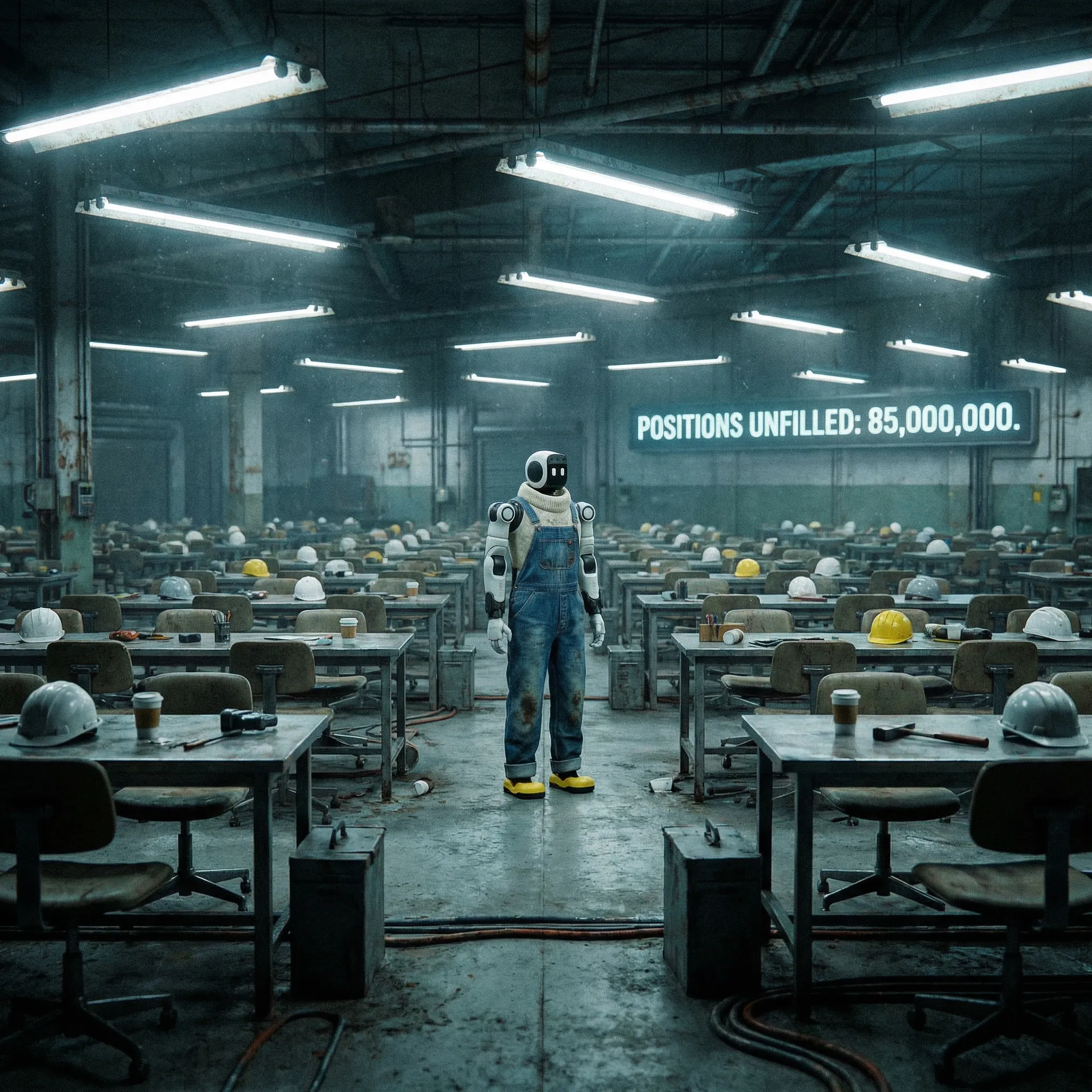
There is a number that should be dominating every boardroom conversation and isn't. $8.5 trillion. That's the amount of annual revenue Korn Ferry projects will go unrealized by 2030 because there simply aren't enough workers to generate it. Not because of automation. Not because of recession. Because of math.
The world is running out of people who can work.
The numbers behind the gap
By 2030, the global economy will be short approximately 85 million workers. To put that in perspective, that's more than the entire population of Germany. Korn Ferry's data breaks it down by region: the Americas face a deficit of 12.4 million workers, EMEA 14.3 million, and Asia-Pacific a staggering 47 million.
This isn't speculation. The people who would fill these roles in 2030 have already been born — or haven't been. In South Korea, the fertility rate hit 0.72 in 2023 — the lowest national rate ever recorded. Japan is at 1.15. Italy at 1.18. Germany at 1.35. Every single one is well below the 2.1 replacement threshold.
The working-age population has already peaked in several major OECD economies — South Korea, Japan, Germany, and much of Southern Europe. In these countries, the labor force isn't just slowing. It's shrinking.
Which industries get hit first
Healthcare is the canary. The WHO estimates a global shortage of 11 million health workers by 2030. In nursing alone, the US is projected to need 200,000 new registered nurses every year through 2031 just to keep up with retirements and demand.
Manufacturing is next. In the US, the National Association of Manufacturers projects 2.1 million unfilled manufacturing jobs by 2030, with a potential economic impact of $1 trillion. Germany — Europe's industrial engine — expects to lose 7 million skilled workers by 2035 as baby boomers retire.
Then there's hospitality. Construction. Logistics. Education. The pattern is the same everywhere: demand rising, supply falling, and the gap widening every year.
The aging math
By 2030, one in six people globally will be over 60. By 2050, over 2 billion people will be 60 or older. In Europe, that ratio will be one in three. Japan already has more adult diapers sold annually than baby diapers — and has since 2011.
The dependency ratio — the number of retirees supported by each working-age adult — is inverting across every developed economy. Fewer workers supporting more retirees, with no reversal in sight.
Fewer workers supporting more retirees, producing less output, generating less tax revenue. The arithmetic is unforgiving.
What happens when the gap arrives
Some version of the gap is already here. The US has roughly 7 million unfilled positions. 75% of employers globally report they cannot find workers with the skills they need, according to ManpowerGroup — up from 36% a decade ago.
Businesses don't just lose revenue when they can't hire. They lose customers, miss deadlines, burn out existing staff, and ultimately shrink. The $8.5 trillion isn't hypothetical economic damage — it's the aggregate of millions of businesses that simply can't operate at capacity because the humans aren't there.
Immigration helps at the margins but doesn't solve the structural problem. Every developed economy is fishing from the same shrinking pond. Upskilling programs take years to produce results. Raising retirement ages buys time but doesn't reverse demographics.
The only variable left
When you can't increase the number of humans, you increase the output per human. Or you fill roles with something that isn't human at all.
This isn't a philosophical debate anymore. It's an operational one. The businesses that figure out how to maintain capacity with fewer people will survive the 2030s. The ones that don't will be part of the $8.5 trillion that never gets realized.
The talent gap isn't a problem that's coming. It's a problem that's already here, getting worse by the year, and governed by demographics that no policy can reverse in time. The only question is what you do about it before the math catches up.