Robot of the Year
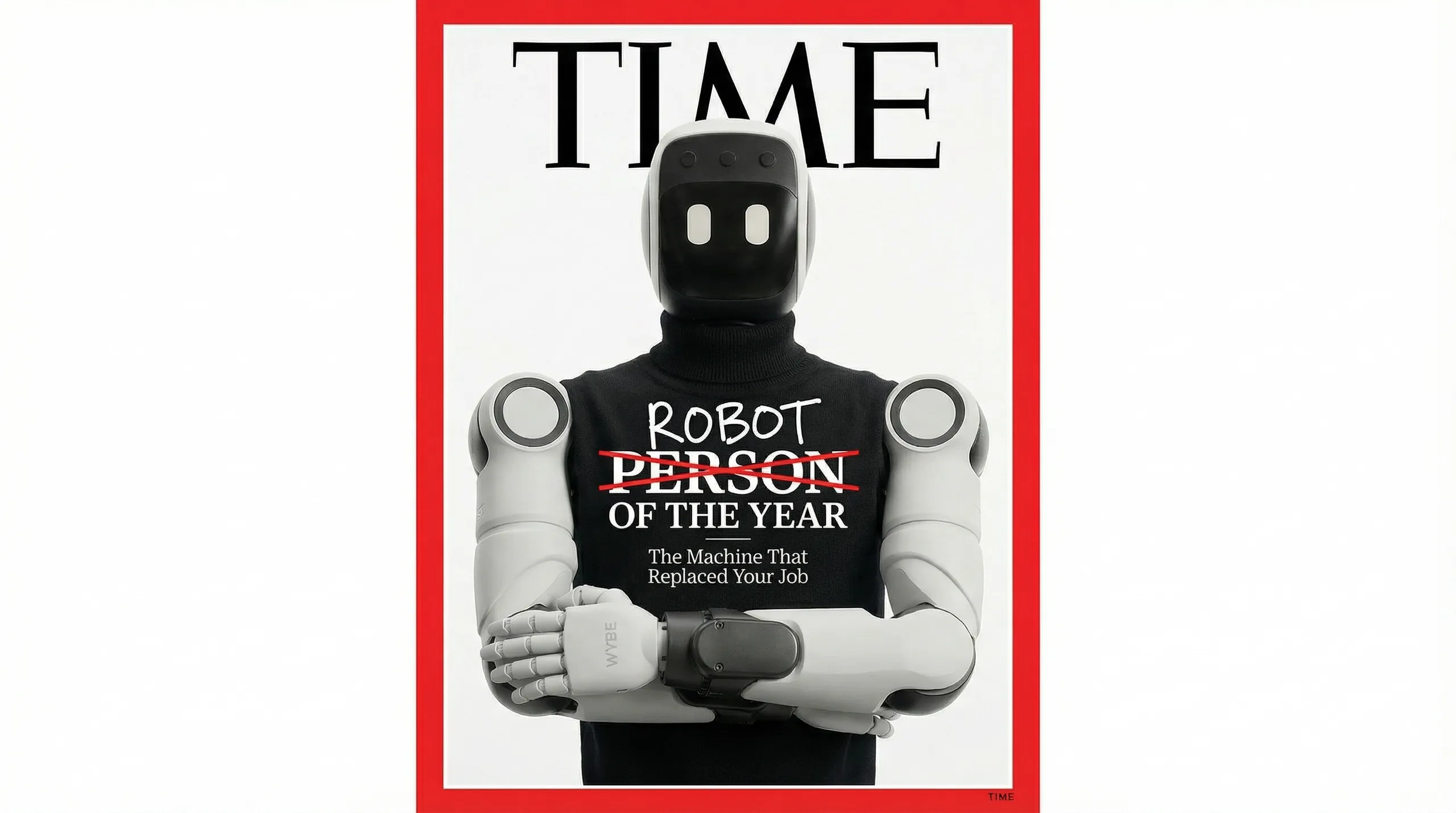
South Korea now has 1,012 robots per 10,000 factory workers. One robot for every ten humans. Seven years ago, the global average was 74. Today it's 162. It doubled while most people weren't paying attention.
This isn't coming. It's here.
The numbers no one tells you
Goldman Sachs 6x'd their humanoid robot forecast — from $6 billion to $38 billion by 2035. Their reason? "AI progress surprised us the most." The manufacturing cost of a humanoid robot dropped roughly 40% between 2023 and 2025. A robot's energy cost can be as low as $0.36 per hour to operate. A fully loaded employee in Western Europe or the Nordics costs $45–55 per hour.
In 2025, roughly 13,000 humanoid robots shipped worldwide. 90% of them were made in China. They have 140 companies building humanoids. 330 different models. Unitree alone is targeting 20,000 units in 2026.
Meanwhile, generative AI reached 39% global adoption in two years. The internet took five. Personal computers took twelve. AI is faster because it doesn't need new hardware — it rides on infrastructure that already exists.
The gap that's forcing the change
By 2030, the world will be short 85 million workers. That's roughly the population of Germany — just missing. Korn Ferry estimates this will leave $8.5 trillion in annual revenue unrealized. Not because businesses don't want to hire. Because there aren't enough people.
The US has 7 million unfilled positions right now. Germany is projected to lose 7 million skilled workers by 2035. By 2030, one in six people globally will be over 60. Birth rates are below replacement in nearly every developed economy.
74% of employers globally say they cannot find the skilled workers they need. Not "would prefer" — cannot find.
This isn't a trend. It's a structural shift. The workforce is shrinking, and it's not coming back.
What's already automated (and you probably didn't know)
Gartner predicts AI will cut $80 billion from contact center agent labor costs by 2026. Not someday. This year. By 2029, agentic AI will autonomously resolve 80% of common customer service issues without a human involved.
McKinsey estimates that 57% of all US work hours could theoretically be automated with technology that exists today. Not future technology. Current technology.
78% of businesses already use AI for at least one function. 99% of Fortune 500 companies. Even among small businesses, adoption jumped from 23% to 58% in two years.
Two options
You can wait. See how it plays out. Hope your industry is different.
Or you can look at the numbers, look at the trajectory, and realize that the businesses moving now are the ones that will still be standing in five years. Not because they replaced their people — because they filled the roles they couldn't fill, at a cost that makes sense, with technology that gets better every single day.
The robot revolution isn't dramatic. There's no uprising. No factory floor takeover. It's a small black box on a shelf. A humanoid that shows up for the night shift. A voice that picks up the phone at 3 AM in whatever language the caller speaks.
It's already happening. The only question is whether you're part of it, or watching from the sideline.