China Is Building 20,000 Humanoid Robots This Year (And You Should Pay Attention)
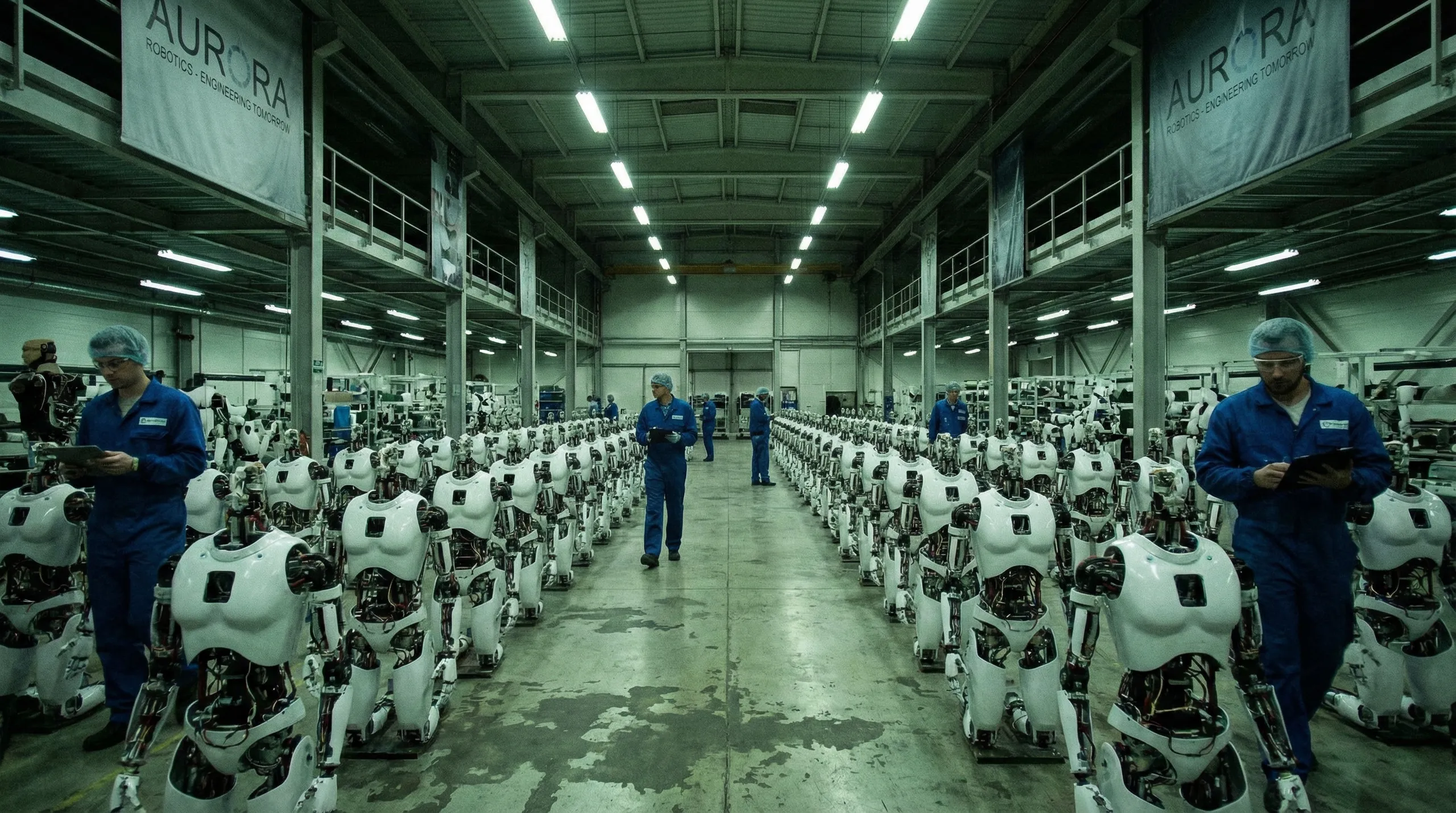
In 2023, the global humanoid robot industry was a curiosity. Boston Dynamics videos on YouTube. Tesla promising Optimus "soon." Interesting, but distant.
Then China decided it was a national priority. And the numbers since then have been staggering.
The scale is hard to comprehend
China now has over 140 companies building humanoid robots. They've produced more than 330 distinct models. In 2025, Chinese manufacturers shipped roughly 90% of the world's humanoid robots. Unitree — a company most Westerners have never heard of — is targeting 20,000 units in 2026 alone, at price points starting under $10,000 per unit.
For context, Tesla has shipped zero Optimus units commercially. Figure AI has shipped prototypes. In the time it took Western companies to produce pitch decks, Chinese manufacturers built factories.
AgiBot, backed by Shanghai's AI ecosystem, secured deals to deploy humanoid robots on production lines in late 2025. Not prototypes in a lab — units destined for real factory floors, doing real assembly work.
Why China moved first
Three structural advantages. First, manufacturing infrastructure. China already builds 50% of the world's industrial robots. The supply chains for motors, sensors, actuators, and batteries are domestic. When Unitree needs a custom servo motor, they source it from a factory 40 kilometers away. When a US company needs the same part, it ships from Shenzhen.
Second, government coordination. In November 2023, China's Ministry of Industry and Information Technology published a national guideline specifically for humanoid robots, targeting mass production by 2025. Provincial governments followed with subsidies, land grants, and procurement guarantees. Beijing alone established a dedicated humanoid robot innovation center, part of a broader city-level robotics fund exceeding $1 billion.
Third, demographic urgency. China's working-age population peaked in 2015 and has been declining since. The country lost 8.5 million working-age people in 2023 alone. By 2035, China will have 400 million people over 60. The government isn't investing in humanoid robots because it's exciting. It's investing because the alternative is economic contraction.
The Goldman Sachs revision
Goldman Sachs originally projected the humanoid robot market would reach $6 billion by 2035. In early 2024, they revised that to $38 billion — a 6x increase in a single forecast update. Their analysts cited two reasons: faster-than-expected AI progress, and faster-than-expected manufacturing cost reductions.
The manufacturing cost of a humanoid robot dropped roughly 40% between 2023 and 2025, driven almost entirely by Chinese production scaling. At current trajectories, Goldman projects the per-unit cost of a general-purpose humanoid could fall below $10,000 by 2030 — roughly the price of a used car.
At that price point, the total addressable market isn't factories. It's everything. Warehouses, hotels, elder care, retail, agriculture. Any role that involves physical presence and repetitive movement.
What the West is doing (and not doing)
The US has strong AI research. Arguably the strongest. But research and production are different things. America's humanoid robotics companies are well-funded — Figure AI has raised over $1.5 billion across multiple rounds, Tesla has unlimited capital — but none have achieved mass production. Europe has a handful of contenders — Norway's 1X Technologies, Germany's Neura Robotics — but none have reached mass production scale.
This mirrors a pattern the West has seen before. The US invented the lithium-ion battery. China manufactures 77% of them. The US pioneered solar cell technology. China produces 80% of the world's solar panels. The US created the smartphone. China assembles most of them.
The humanoid robot industry is following the same trajectory. And it's moving faster than any of those precedents because AI development is accelerating the iteration cycle. A humanoid robot's software improves every week. Its hardware iterates every quarter. By the time a Western competitor reaches production scale, Chinese companies will be on their third or fourth generation.
What this means
The new space race isn't happening in orbit. It's happening on factory floors, in warehouses, in hotel lobbies. The countries and companies that figure out human-robot integration first will have an economic advantage that compounds over decades.
China is treating humanoid robots as critical infrastructure — as essential as highways or power grids. The West is still treating them as a technology experiment.
That gap is widening every quarter. And unlike software, where a startup can catch up with a clever algorithm, hardware manufacturing advantages are extremely difficult to reverse. They require factories, supply chains, skilled labor, and years of iteration.
The window for the West to compete in humanoid robotics manufacturing is still open. But it's closing faster than most people realize.